NVIDIA Took Claude From 30% to 100% Without Touching the Model
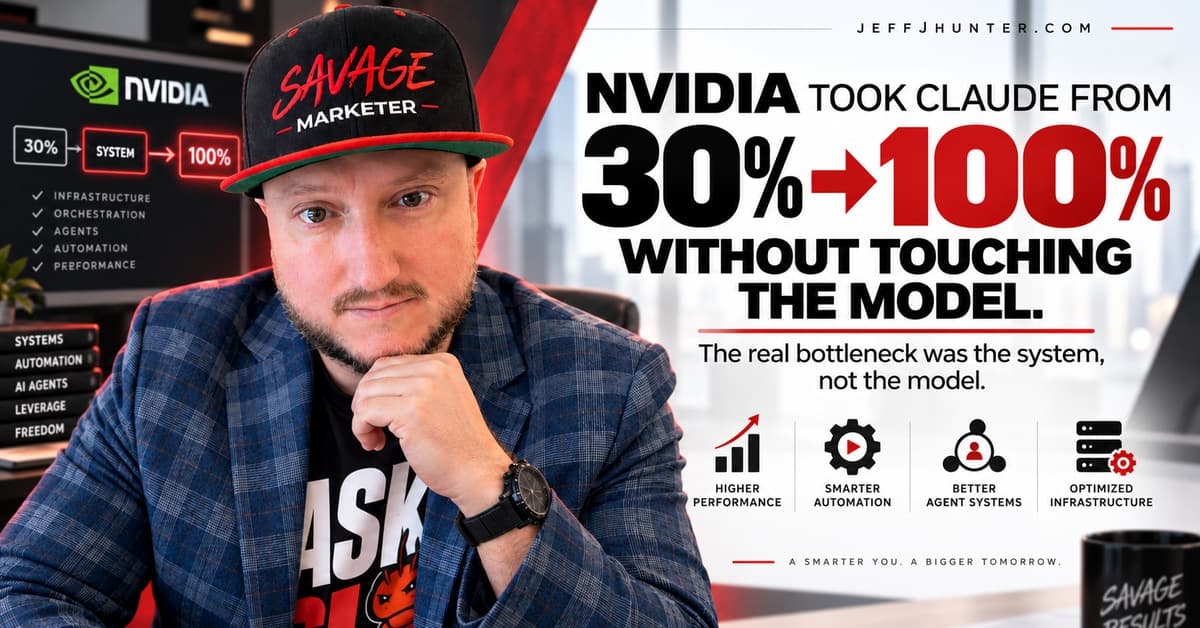
NVIDIA published research this week showing Claude Opus 5 scoring 30% on a benchmark by itself, and 100% on the same benchmark inside their agent architecture. Same model. The only thing that changed was the system built around it.
I have been arguing this since I started building AI Personas. An AI Persona is not a prompt. It is identity, knowledge, tools, memory, workflows, guardrails, and a human being who is accountable for the output. People told me I was overcomplicating a chatbot.
Turns out I was describing an architecture.
What NVIDIA Actually Published
The project is called AVO, short for Agentic Variation Operators. It is not a chatbot and not a consumer product. It is experimental agent architecture built to keep an AI working reliably through long, multi-step assignments.
They tested it on ARC-AGI-3, which is deliberately brutal. The agent gets no instructions. It has to infer the rules by experimenting, remember what it learns, and clear progressively harder levels.
- Claude Opus 5 on its own: a 30% baseline.
- The complete AVO system: a 100.00 score.
- All 183 levels across 25 environments.
- Roughly 12% fewer environment actions than VISTA, a different harness running the same underlying model.
One honest caveat, and NVIDIA states it themselves: this is not a controlled ablation. The two systems differ in memory, context management, observation format, and execution, so you cannot claim architecture reliably adds 70 points. What it does prove is narrower and more useful. Evaluating a raw model and evaluating a complete agent are two different activities, and most people are doing the first while shopping for the second.
The Harness Is the Product
The model is the reasoning engine. The harness is the operating system wrapped around it.
- What context the model receives
- Which tools it can actually use
- How actions get executed and checked
- What gets written to persistent memory
- How progress is measured and failure is detected
- When the job is done, and when a human needs to step in
NVIDIA's primary agent runs a loop: inspect the state, form a hypothesis, take an action, run a real test, read the result, store what it learned, revise, continue.
Then there is a second agent watching the first one. If the worker starts looping, stalling, or chasing a dead end, the supervisor redirects it. TechCrunch described that supervisor as behaving something like a CEO managing the agent doing the work.
Read that again if you run a team. NVIDIA independently arrived at a manager.
Memory Is What Makes It a Job Instead of a Chat
AVO does not live inside the current context window. It keeps previous implementations, test results, tool outputs, failed approaches, useful discoveries, and current progress.
That means it resumes from accumulated work instead of rebuilding its understanding from scratch every session. Which is the entire difference between a tool you re-brief every morning and an employee who remembers Tuesday.
NVIDIA proved this on GPU kernel optimization. The agent ran for seven days straight.
- Explored more than 500 optimization directions
- Committed 40 kernel versions
- Produced kernels up to 10.5% faster than FlashAttention-4 on NVIDIA DGX B200 systems
Seven days of unsupervised engineering that beat a hand-tuned industry standard. Not because the model got smarter. Because the system let it keep working.
They Also Built the Boring Part Right
A related NVIDIA preview called NOOA treats an agent as an ordinary Python class. Methods are capabilities. Fields hold explicit state. Docstrings carry instructions. Type annotations enforce contracts. Plain deterministic code handles the rules that should never depend on a model's judgment.
Their six principles:
- Typed inputs and outputs
- Pass large data by reference instead of stuffing it into prompts
- Use executable code for actions
- Make the orchestration loop programmable
- Keep explicit persistent state
- Let the agent inspect and manage its own context
NVIDIA reports this produced large performance differences using the same model while cutting token use, including a SWE-bench comparison where it used roughly half the tokens and still matched or beat the harnesses it was measured against.
Half the tokens, same model. That is a margin story, not a benchmark story, and it is the part your accountant should care about.
And They Stopped Paying Frontier Prices for Everything
NVIDIA's NeMo Switchyard routes different steps of a workflow to different models based on required capability, cost, latency, infrastructure conditions, and escalation rules.
A routine classification goes to something small and cheap. Strategic reasoning goes to a frontier model. Validation goes to deterministic code that costs nothing and never hallucinates. NVIDIA calls this a system of models rather than a one-model agent.
Same logic as staffing a company. You do not put your highest-paid strategist on data entry.
Now Here Is Why I Am Writing This
Line up what NVIDIA built against what I have been building and teaching.
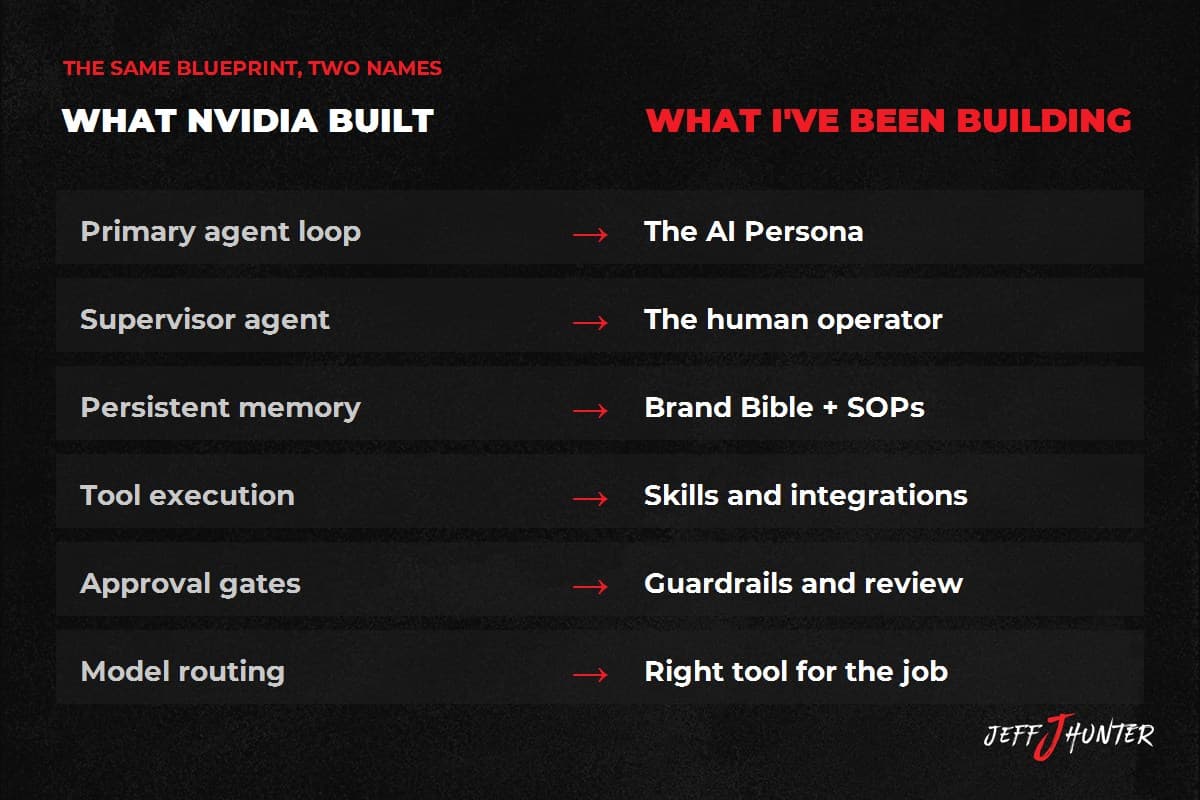
The AI Persona and Brand Bible are stable identity and judgment. Skills and SOPs are repeatable procedures. Tools are the capacity to act. Memory is organizational continuity. The supervisor is management. The human operator is accountability. Tests and approval gates are what make output dependable. Model routing is what makes it affordable.
It also validates the Humans + AI structure specifically. NVIDIA did not build an autonomous agent and walk away. They built an agent that does bounded production work, with a supervisor watching the trajectory, and humans owning the decisions that matter.
That is the exact shape I have been arguing for while everybody else was promising AI would replace their staff.
The Buying Question Everyone Gets Wrong
Most businesses are shopping for the smartest model. NVIDIA's work suggests that is the wrong purchase decision. The better questions:
- Does the agent remember your business?
- Does it know which sources are authoritative?
- Can it use the tools the work actually requires?
- Are outputs structurally validated, not just plausible?
- Can it recognize its own failure?
- Is there a supervisor?
- Are risky actions gated behind approval?
- Can the work be audited and rolled back?
- Can cheaper models handle the routine steps?
- Does the system get better as work accumulates?
A powerful model inside a weak system gives you an impressive demo. A well-built harness gives you a functioning AI employee.
Stop buying smarter models.
Start building better AI employees.
NVIDIA supplied the proof point: 30% raw, 100% assembled. The lesson is not that the model does not matter. It is that architecture decides how much of the model you actually get to use.
If you want the version of this built for a business instead of a research lab, that is what the AI Persona Method is, and it is what we deploy inside Humans + AI.