AI and the Future of Work: Who Actually Wins
The headlines swing between two extremes: AI is about to hand us a utopia of four-hour workweeks, or it is about to put everyone out of a job. Both are clickbait. The real future of work is more boring, more specific, and far more useful to plan around. Let me give you the honest read.
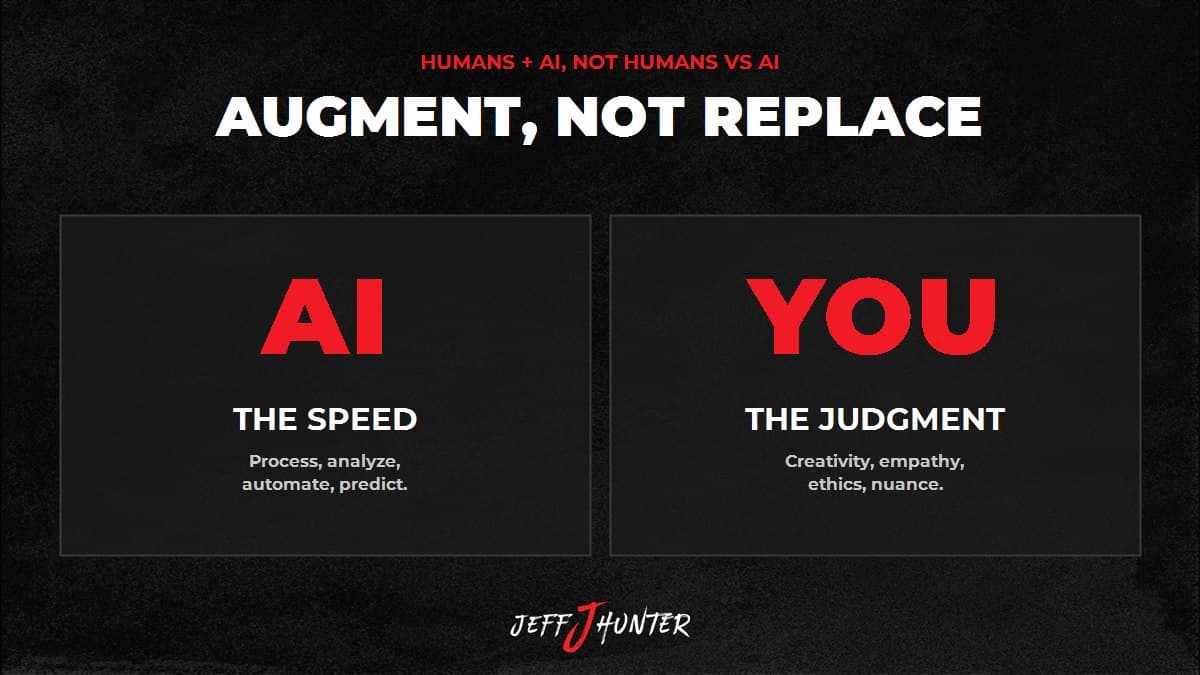
When people picture AI in the workplace, they imagine a robot sitting in someone's chair. That is not what is happening. Today's AI is a set of very capable tools that handle specific slices of work: pattern recognition, data processing, drafting, and the repetitive stuff that eats your week. It is closer to a calculator that learned to write than a colleague that learned to think. It enhances what a person can do. It does not replace the person.
That distinction is the whole game. Get it right and AI becomes the biggest leverage of your career. Get it wrong - treat it as a threat to hide from, or a magic button to lean on entirely - and you end up on the wrong side of the shift.
What AI Actually Does Well (And Where It Falls Apart)
Be honest about both columns, because your career strategy lives in the gap between them.
- It is great at: processing huge datasets fast, automating rule-based tasks, spotting patterns and making predictions from history, and generating first-draft content on demand.
- It is still bad at: original thinking, genuine empathy, ethical judgment in messy situations, adapting to something truly new, and reading the unspoken context in a room.
Notice the pattern. AI owns the predictable. Humans own the novel, the relational, and the high-stakes judgment call. The future workplace is not humans versus AI. It is humans pointing AI at the right problems and keeping their hands on the wheel.
Jobs Are Changing, Not Disappearing
History is calm about this even when the headlines are not. Every major technology shift has transformed work rather than ended it. The industrial revolution did not delete employment. It rewrote what employment meant and invented whole new categories of it. AI is running the same play.
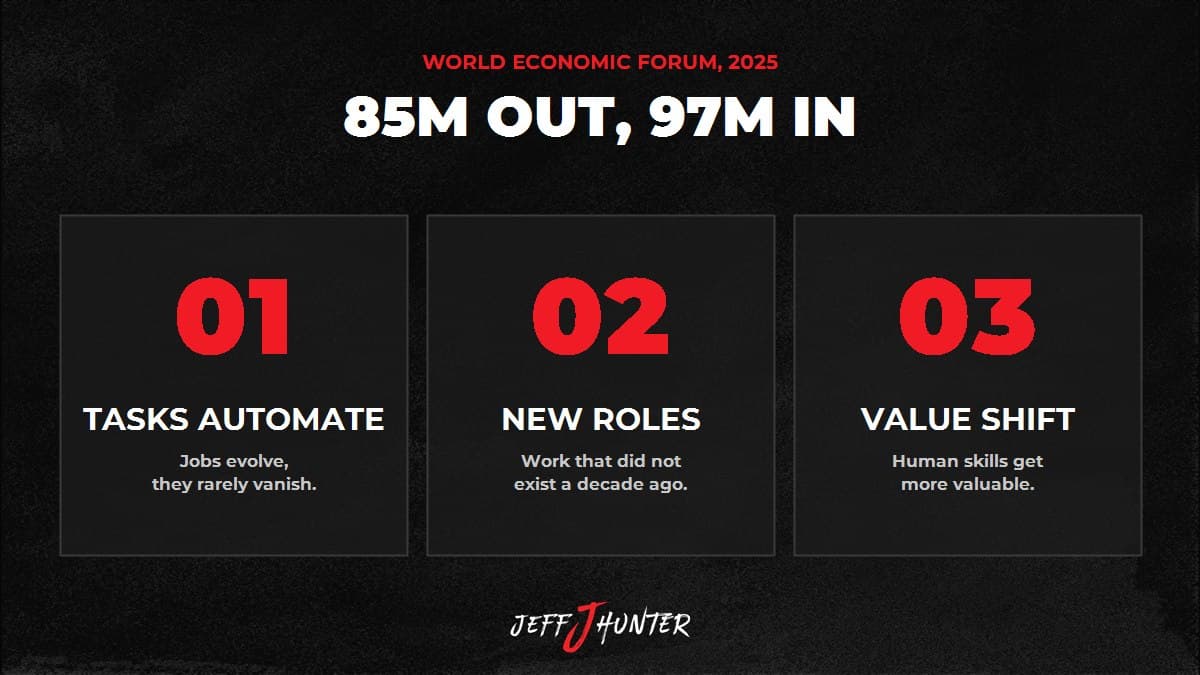
- Tasks automate, jobs evolve. Most jobs are a bundle of tasks, and only some are automatable. When those get handed to AI, the role shifts up the value chain instead of vanishing.
- New roles appear. AI ethicist, machine-learning ops, human-AI workflow lead. None of those existed a decade ago. More are coming.
- Value moves to the human stuff. Creativity, connection, judgment, and complex problem-solving get more valuable as the routine gets cheaper.
The World Economic Forum put numbers on it: roughly 85 million roles displaced by automation and about 97 million new ones emerging in their place, better suited to a world where humans and machines split the labor. The work does not disappear. It relocates to where you can actually add something.
The Skills That Hold Their Value
You do not need to become a programmer. You need to become fluent in a specific blend of capabilities that AI cannot copy and cannot run without.
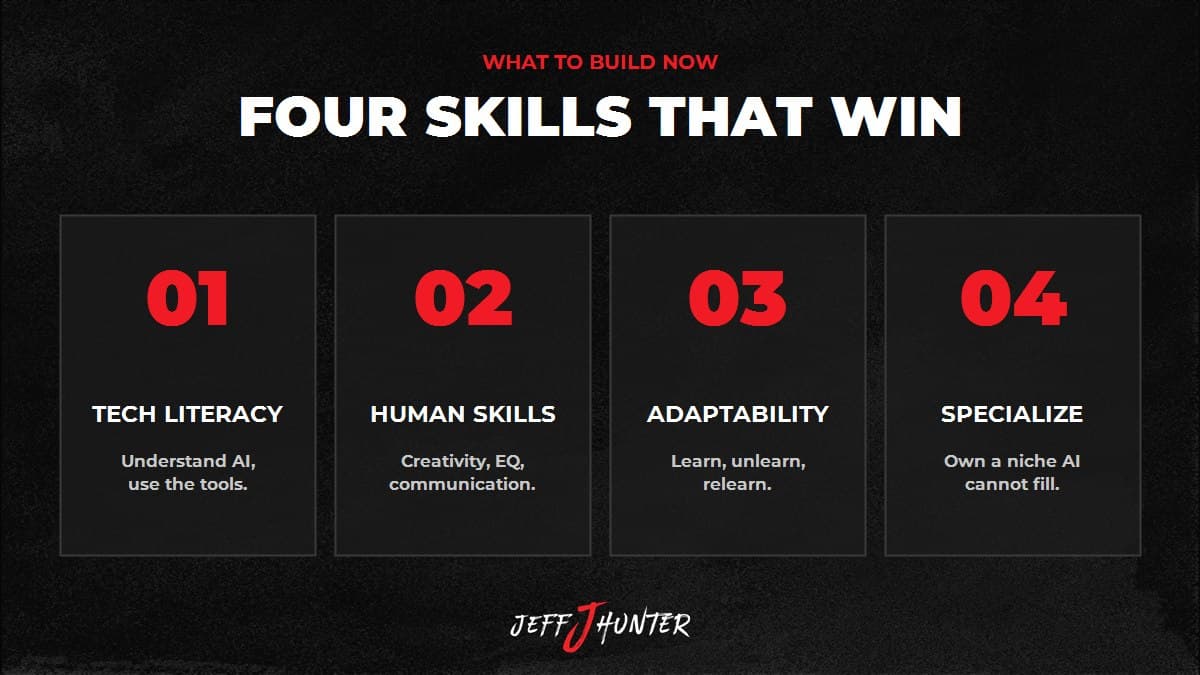
- Technical literacy. Not coding. Just enough understanding of what AI can and cannot do to direct it well and call out when it is wrong.
- Human skills. Creative thinking, emotional intelligence, ethical reasoning, storytelling, and the kind of leadership that pulls a team together.
- Adaptability. The meta-skill. The willingness to learn, unlearn, and relearn as the tools change under you every few months.
- Specialization. Deep expertise in a domain or a function, so you become the person who knows exactly where AI fits in your specific world.
The professionals who win the next decade are translators. They sit between what AI can do and what humans actually need, and they make the two meet. This is the same shift I describe in how to become an AI expert, and it is the practical path, not the PhD one.
How to Get Ready Without Getting Overwhelmed
You do not prepare for this with a five-year plan. You prepare with reps. Pick one AI tool relevant to your work and use it on real, low-stakes tasks this week. Get comfortable with its strengths and its failure modes. Then double down on the human skills AI cannot touch: have the hard conversation, tell the better story, make the judgment call. Finally, find your niche - the intersection of your expertise, your strengths, and where AI can amplify you - and plant a flag there.
Augmentation, not automation. The biggest wins do not come from replacing people with AI. They come from a person who is dramatically better because they know how to use it. That person is not at risk. That person is the new standard.
The future of work is not something that happens to you. It is something you help build with your choices. Treat AI as a power tool instead of a threat, keep your hands on the parts that need a human, and you do not just survive the shift. You become more valuable because of it. That is the entire thesis of Humans + AI, and it is the same logic behind the 90/10 Rule: let the machine carry the 90% so you can spend your time on the 10% that only you can do.