Yes, AI Will Steal Your VA Job (And Here's What You Can Do)
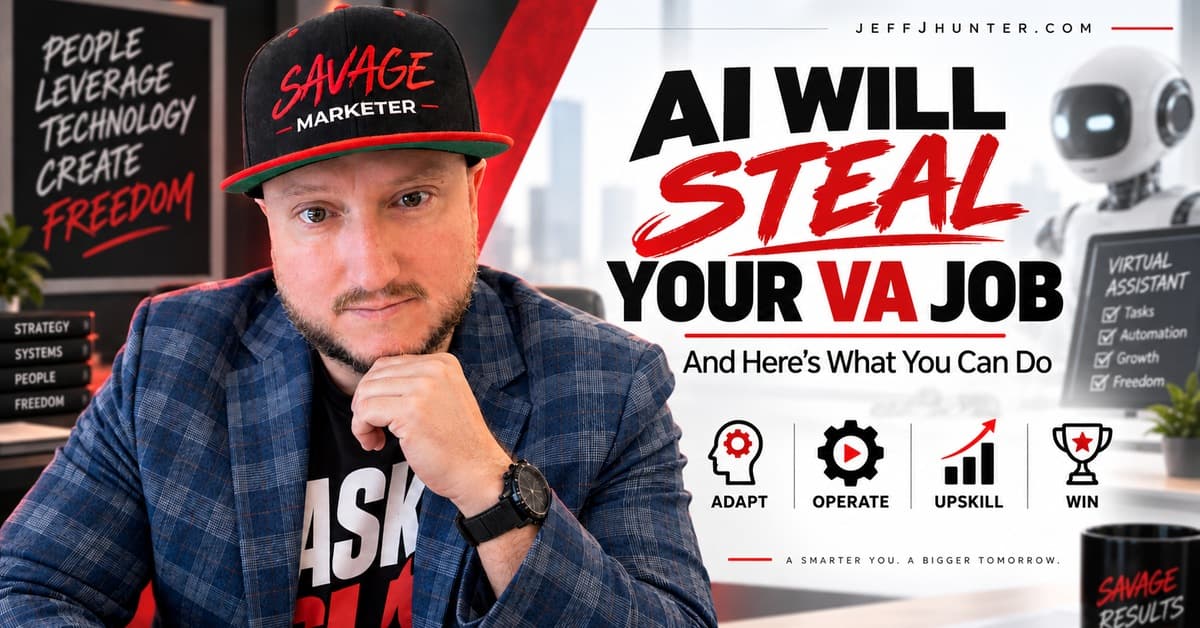
I am not going to sugarcoat it. AI is coming for the routine parts of virtual assistant work, and it is already here. But here is what most people miss: the VAs who lean into it do not lose their jobs. They become the most valuable person on the team.
When ChatGPT landed, I did not wait to see what would happen to my agency. I flew to the Philippines, stood up an AI Division inside VA Staffer, and personally retrained my team into AI Operators. Not because I had to. Because the future of work was changing in real time, and I refused to let my people get left behind.
What AI Can Already Do
Be honest about the parts of the job that are now automatable:
- Customer support. AI sorts, drafts, and sends responses to routine inquiries with light supervision.
- Scheduling. AI coordinates meetings across calendars with zero back-and-forth.
- Data entry. Database updates and transcription, fast and accurate.
- Basic research. Gathering and compiling information into clean summaries.
If your entire value is doing those four things, yes, you should be concerned. They are cheaper, faster, and available 24/7 when a machine does them.
Why You Should Be Concerned (For Real)
I am not in the business of false comfort, so let me name the threat plainly. For a small business owner deciding between a human VA and an AI tool for routine work, the math is getting hard to argue with:
- Cost. AI handles repetitive tasks for a fraction of a salary, with no benefits, no onboarding, no turnover.
- Availability. It works at 3am on a holiday. It does not get tired, sick, or distracted.
- Scale. One operator can run a dozen AI workflows at once. Humans do not scale that way.
- Speed. On repetitive, rules-based work, AI is simply faster, often by an order of magnitude.
If your entire offer is "I will do the repetitive tasks," that offer is depreciating in real time. Pretending otherwise is how you get blindsided. The good news is that the repetitive tasks were never where your real value lived anyway.
What AI Still Cannot Do
AI is a brilliant intern with no judgment. It is confident, fast, and occasionally completely wrong in ways it cannot detect. Here is where it consistently falls down:
- Context. It struggles with nuance, cultural subtext, and the unspoken parts of communication. It does not feel the room.
- Judgment. In genuinely ambiguous situations, it cannot weigh tradeoffs the way a seasoned human can. It pattern-matches; it does not deliberate.
- Adaptability. Throw it something truly novel, outside its training, and it flails or hallucinates.
- Initiative. It does the task you gave it. It will not notice the unarticulated need, the better idea, or the quiet thing that is about to go wrong.
AI can vs cannot
The work that disappears is task execution. The work that explodes in value is judgment, relationships, and knowing which AI to point at which problem. That is the job now.
The Skills That Make You Irreplaceable
These are the capabilities a machine cannot copy. They are also, not coincidentally, the ones that have always separated a great assistant from an average one:
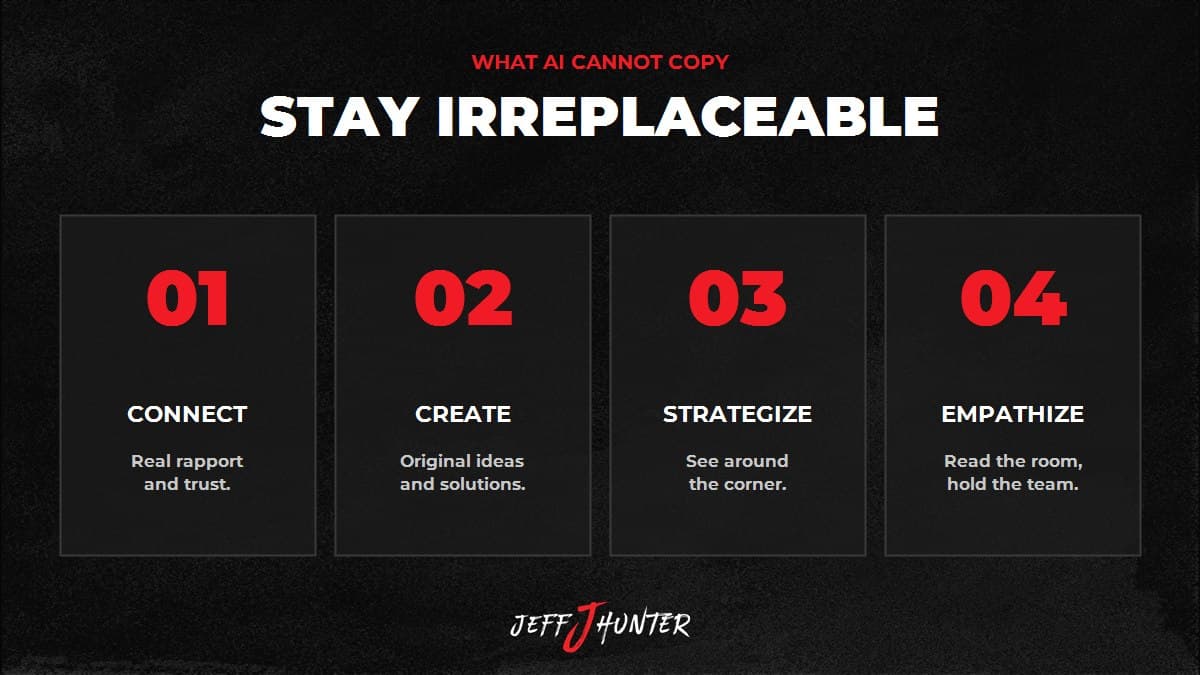
- Human connection. Building real rapport and trust, representing a brand through authentic interaction, anticipating needs from patterns you have actually lived.
- Creative thinking. Inventing solutions to problems nobody saw coming, spotting the inefficiency everyone else stopped noticing, making something genuinely original.
- Strategic planning. Sitting in the strategy conversation and adding insight, prioritizing resources intelligently, seeing around the next corner.
- Emotional intelligence. Reading a client's stress and adjusting, handling the hard conversation with tact, holding a team together when things wobble.
How to Future-Proof Yourself (Become an AI Operator)
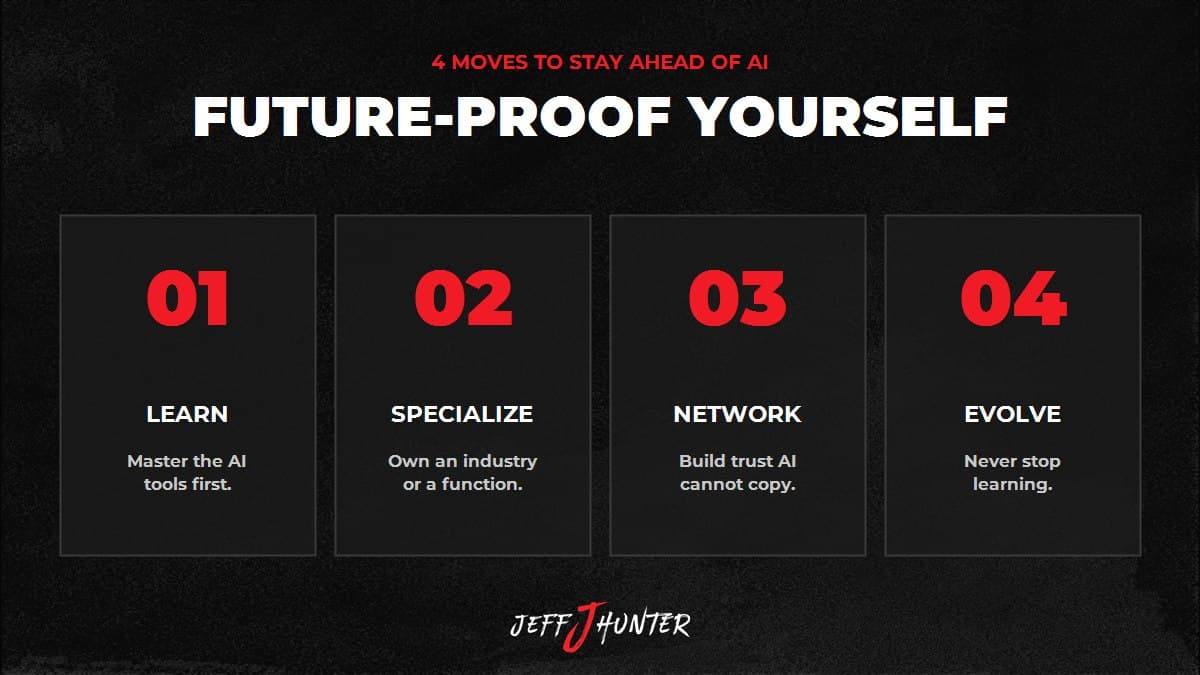
This is the exact shift I trained my Philippines team through, and the same path I walk through step by step in how to become an AI expert. It is four moves:
- Learn the technology. Master ChatGPT, Claude, and automation platforms. Become the person who makes AI produce great output instead of generic slop. The goal is to be the AI quality overseer, not the AI competitor.
- Specialize. Develop deep industry expertise (legal, medical, real estate, e-commerce) or own a high-value function end to end (content, social, podcasting, ops). Generalists get automated. Specialists get retained.
- Build networks. Engage with communities, build relationships with other operators, establish visible thought leadership, and deepen the client relationships you already have. Trust is a moat AI cannot dig.
- Never stop learning. Pursue certifications, watch the trends, and actively seek feedback. The landscape changes monthly. The willingness to keep up is itself the competitive advantage.
The Role Is Evolving, Not Disappearing
The VA role is shifting from task execution to task management, from support to strategy, from reactive to proactive. The assistants who understand this do not compete with AI. They conduct it. They run a stack of AI Employees and deliver ten times the output they used to, and clients pay them more for it, not less, because the value moved up the ladder.
So embrace the change instead of bracing against it. Diversify your skills, focus on solutions, and invest in your own development. The operators who win the next decade are not the ones who do the most tasks. They are the ones who emphasize the distinctly human capabilities AI cannot touch, while leveraging AI's strengths to amplify everything else.
That is the Humans + AI model in one sentence. The human moves up to the 10% that needs a heartbeat. The AI handles the 90% that needs consistency. Nobody who adapts loses their job. The job just got a lot more interesting, and a lot more valuable.