Better Content With AI: The Complete Guide to AI Copywriting Tools
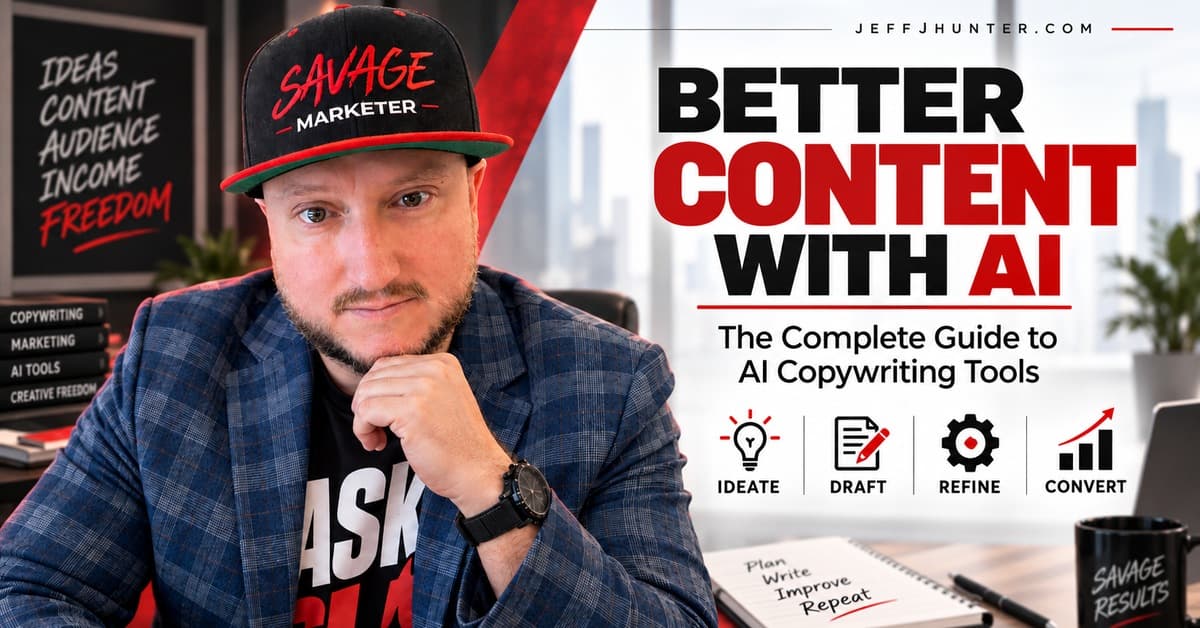
Writer's block is expensive. AI copywriting tools do not just beat the blank page, they give you outlines, headlines, drafts, and variations on demand. But they are an engine, not a strategy. Here is how to get the upside without losing your voice.
What They Do Well (And What They Don't)
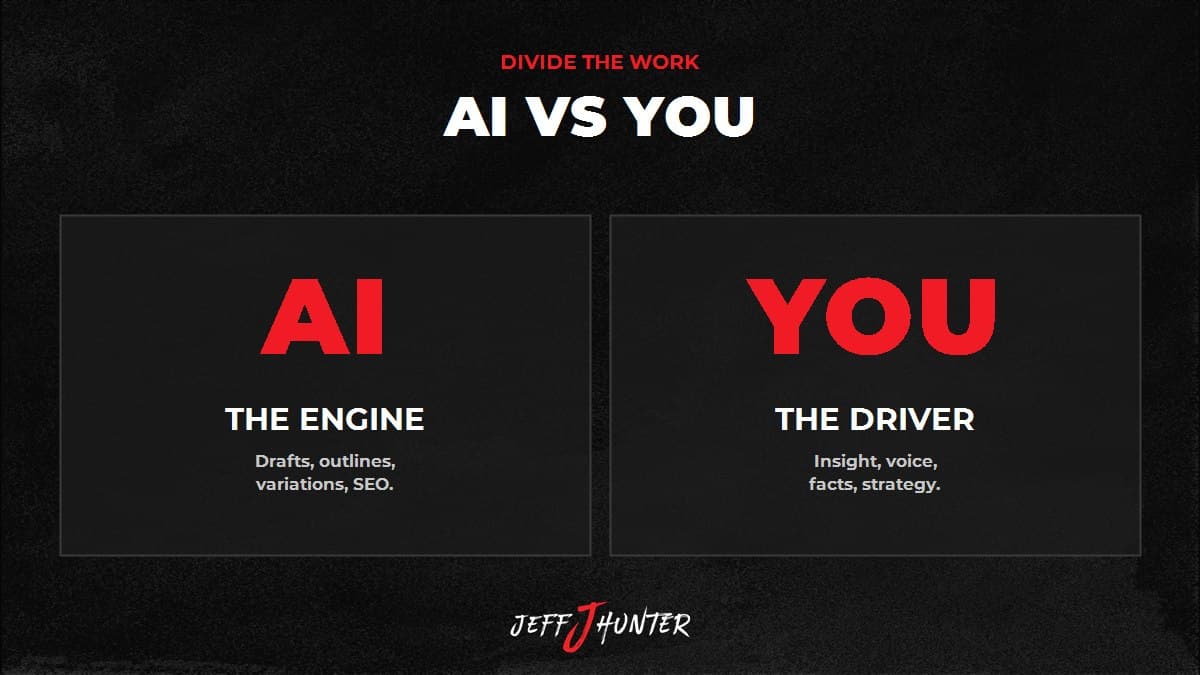
Lean on AI for the mechanical lifting:
- First drafts and variations, fast
- Outlines and content frameworks
- Headline options and alternate angles
- Consistent output across channels, optimized for SEO
Keep the human on the things that actually move people:
- Original insight and a real point of view
- Emotional narrative that lands
- Factual accuracy and brand voice
- The strategic call on what to say in the first place
The Tools, By Category
Still deciding whether any of this is worth the spend? I made the full case in AI Copy Generators: Are They Actually Worth It? Short version: yes, if you have a process. Now the tools.
You do not need every tool. You need one in each lane you actually work in. For marketing copy without the prompt-engineering learning curve, I built AICopyTools. Here is how the rest of the landscape breaks down:
- Long-form generators. Jasper for blog posts and team collaboration, Copy.ai for social and multilingual work, Writesonic for articles with built-in fact-checking.
- SEO and briefs. Frase, MarketMuse, and Clearscope to build data-driven outlines that actually rank.
- Grammar and style. Grammarly, ProWritingAid, and Hemingway as the editing layer that catches what you miss.
A Workflow That Protects Your Brand
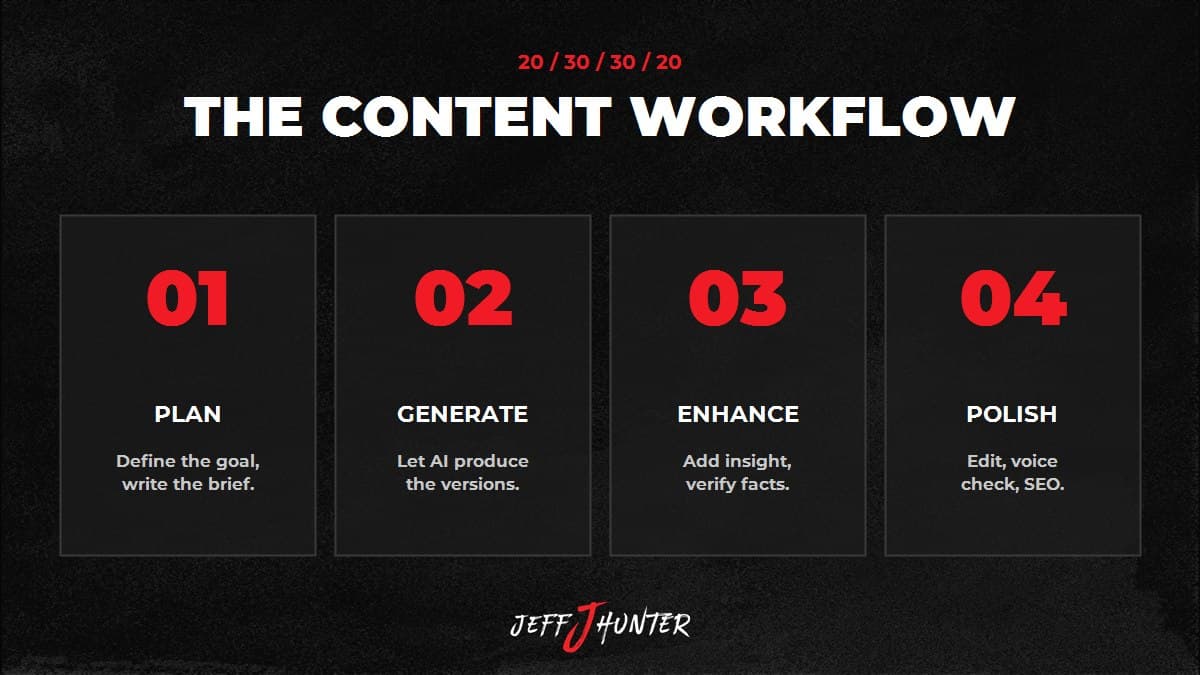
Spend your first week or two on foundation: document your brand guidelines (voice, tone, messaging, the words you do and do not use) and set up a review process with real metrics. Then split every piece of content into four phases:
- Plan (20%). Define the objective and write a tight brief. Garbage brief, garbage output.
- Generate (30%). Let AI produce versions and angles. Quantity here is the point.
- Enhance (30%). Add your insight, your examples, your proof. Verify every fact against a real source.
- Polish (20%). Final edit, voice check, SEO pass.
Notice that 70% of the work is still human. AI compresses the middle. It does not remove the thinking on either end. That ratio is the whole secret.
The Quality Control Framework
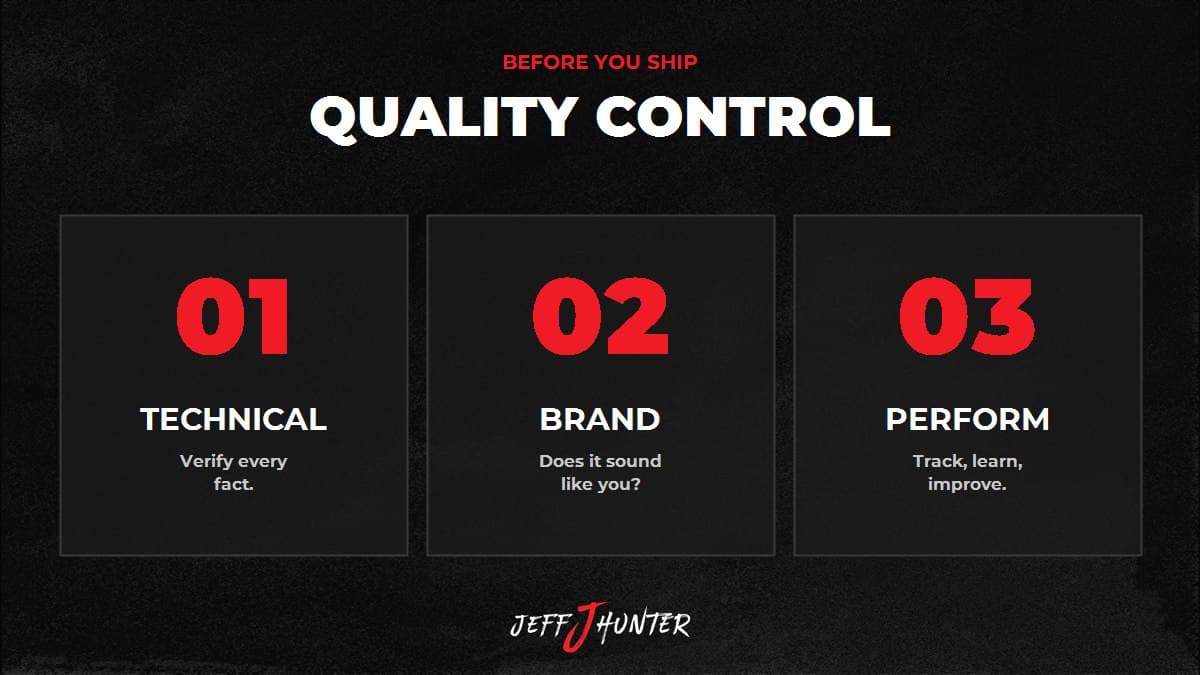
Before anything ships, run it through three filters. This is what keeps AI content from quietly eroding your credibility:
- Technical review. Verify every fact against its source and confirm the terminology is correct. AI states wrong things with total confidence.
- Brand alignment. Does it sound like you? Does it resonate with your actual audience? Does it articulate your value, not a generic version of it?
- Performance optimization. Track engagement, analyze conversions, review the SEO, and collect reader feedback so each piece informs the next.
Authenticity and Ethics
This part is not optional, and it is where a lot of brands quietly cut corners. Run plagiarism checks. Verify sources and facts. Be transparent about AI use when it matters. Keep records of your process. Protect anything sensitive you feed into a tool. And audit your content regularly, because standards slip when nobody is watching. The brands that treat AI content ethically are the ones still trusted in three years.
Measuring Success
If you cannot measure it, you cannot improve it. Watch the metrics that actually tie to outcomes: content production time, publishing frequency, engagement rates, conversion metrics, and ultimately ROI. The point of AI is not to publish more for its own sake. It is to publish more of what works, faster.
Getting Started Without Overthinking It
Pick one tool that matches your most immediate need. Document your brand guidelines so the AI has a target. Test on low-risk content first. Set a measurable goal around production time, consistency, or volume, document the results, and scale only what clears your bar. AI writing tools are meant to amplify human creativity, not replace it. Master the tools, keep your voice, put the audience first, and your content gets better and faster at the same time. That is the whole game.