AI for Small Business: Start Now or Fall Behind
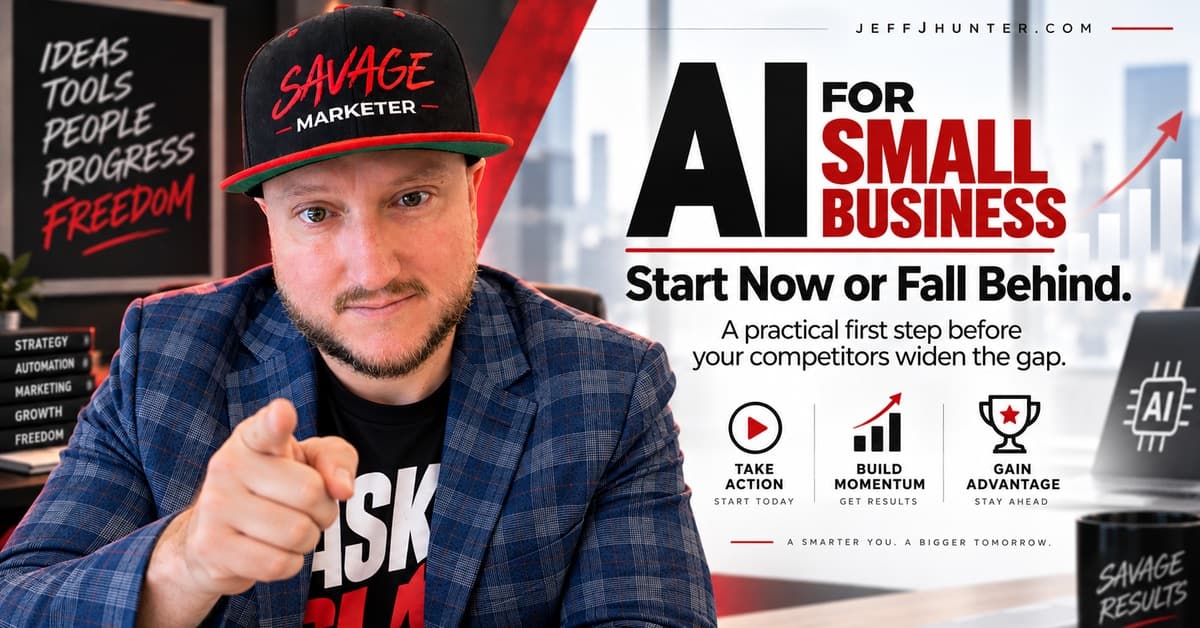
AI stopped being a buzzword the moment it started showing up on your competitors' P&L. It is a practical tool now, not a science-fiction prop, and the gap between businesses that use it and businesses that do not is widening every quarter. Here is the honest case for why waiting is the expensive choice.
Forget the humanoid robots. AI for business is software that handles tasks which normally need human attention: chatbots that answer common questions instantly, tools that forecast inventory, assistants that draft your marketing, systems that flag a fraudulent transaction before it clears. These do not replace your team. They take the routine off your team's plate so the humans can do the work that actually needs a human.
Why the Pressure Is Real
The market is moving, and it is moving in a direction that rewards adoption and punishes delay. Customers now expect instant, personalized, always-on service - and they got that expectation from your competitors. Those competitors are already implementing AI; surveys put the share of companies calling AI mainstream well into the majority. Entire industries are being reshaped by it, from retail to manufacturing to healthcare. And the best talent increasingly wants to work somewhere that uses modern tools. Sitting still is not neutral. It is falling behind while standing in place.
What AI Actually Does for the Bottom Line
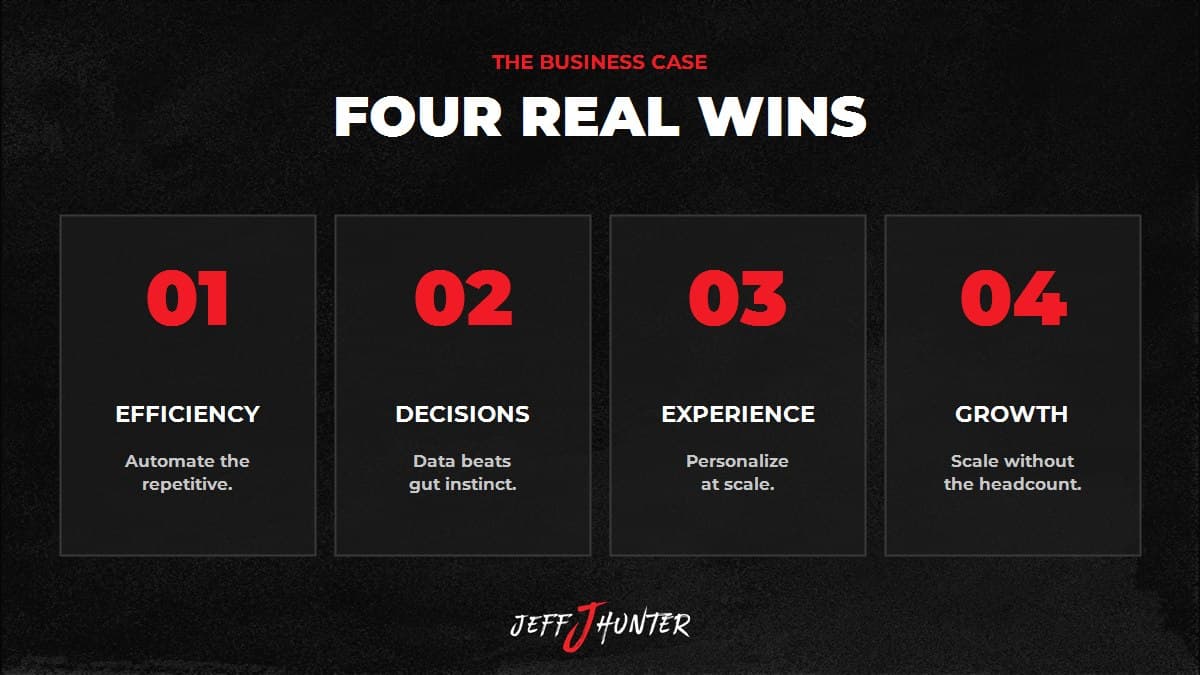
Strip away the hype and the business case is simple. AI moves four numbers that matter.
- Efficiency. Automates repetitive work, cuts errors, and lets your team do more with the same headcount. That is a direct cost saving.
- Decisions. Analyzes more data than a human can, surfacing patterns and predictions that beat gut instinct on inventory, spend, and risk.
- Experience. Personalization at scale, faster responses, and consistent quality - the things that drive loyalty and repeat revenue.
- Growth. Handles more volume without proportional hiring, so you can scale operations without scaling chaos.
These are not theoretical. Businesses are already booking real returns, usually by starting with one focused application that solves one specific pain - a support chatbot, a forecasting tool, an AI marketing assistant - and expanding from there.
How to Start (Without Boiling the Ocean)
The mistake is trying to transform everything at once. The winning move is small, focused, and proven before you scale it.
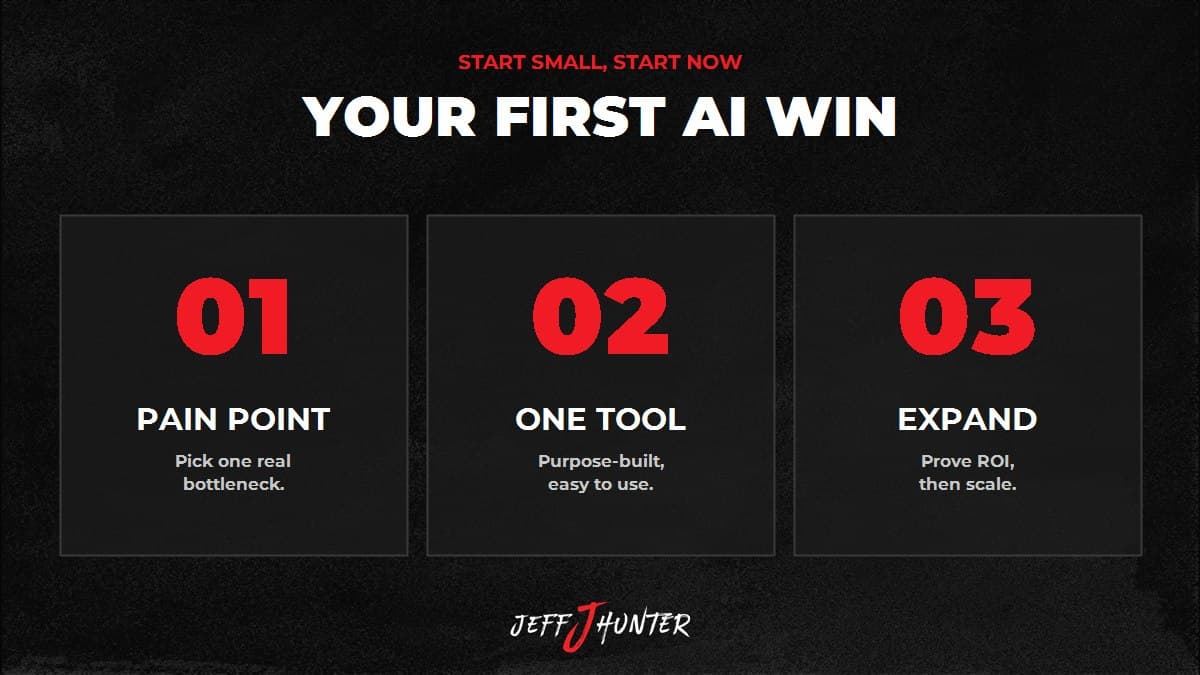
- Pick one pain point. A time-sink, a bottleneck, a forecasting headache. Something specific and measurable.
- Choose one purpose-built tool. Something designed for your problem and your industry, with an interface your team can use without a data-science degree.
- Prove it, then expand. Measure the result against your old baseline. Once it works, take what you learned to the next process.
Bring your team along while you do it. Lead with how the tool makes their work easier, not with the technology. Be straight about the fact that AI is here to supplement them, not replace them - the same message I make to virtual assistants in Yes, AI Will Steal Your VA Job. The people who learn to run the tools become more valuable, not less.
The Real Cost of Waiting
This is the part that should keep you up at night, not the science-fiction stuff. The cost of waiting is not dramatic. It is quiet and compounding.
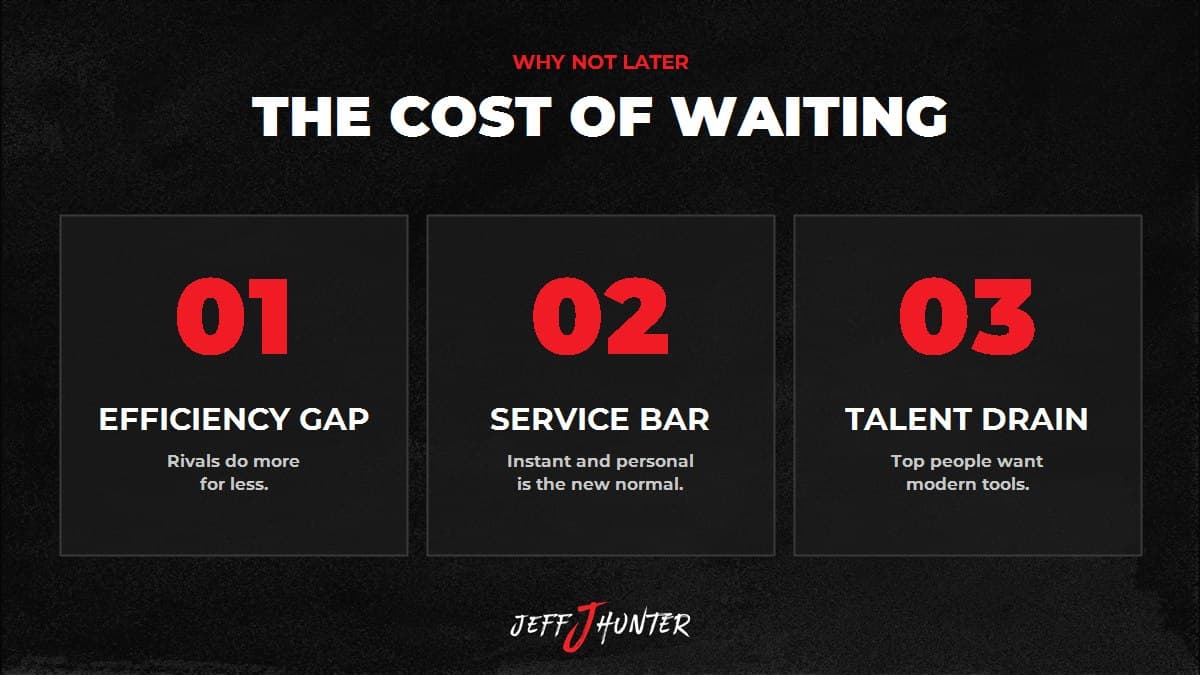
- The efficiency gap. AI-enabled competitors do more for less, which means they can out-price you or out-margin you, your choice of which hurts.
- The service bar. Instant and personalized stops being exceptional and becomes the minimum customers expect. Miss it and you look dated.
- The talent drain. Forward-thinking people gravitate to companies using modern tools, slowly draining the businesses that do not.
The smartest implementations use AI to augment people, not just to cut tasks. Point it at the highest-value problems, keep your team in the loop, and you get buy-in and results at the same time.
The question is no longer whether AI will affect your business. It already is. The only question left is whether you shape that impact or get shaped by it. Start now, even small, and you put yourself in the first group. That is the whole reason you cannot afford to wait.